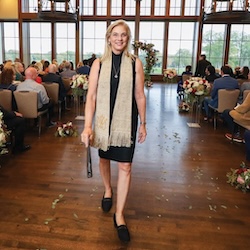
All eyes are on you as you step into the pulpit.
In a time of deep anxiety, your congregation wants answers. They want to know God is listening and to feel God’s presence.
You could offer certainty and explanations—even scapegoats. Instead, you take a breath and move yourself— and your desire to be more liked and trusted—out of the way.
You begin to preach a sermon rooted in Scripture, inviting curiosity and mystery rather than easy answers and conviction. The sacred texts remind those gathered that God will continue to walk alongside them through what is hard, and that faith can hold both suffering and hope.
“It takes courage to be a truthteller in a world with many false prophets,” said Janet Karvonen-Montgomery ’15 M.Div., who, with her husband, Al Montgomery, endowed a fellowship for Luther Seminary graduates to explore ministry and preaching in a variety of domestic and international settings. “In a rapidly changing and divisive world, it is critical to give leaders the time and resources they need to inform the direction of their work and to reimagine the kingdom of God in opportune ways.”
Supporting preachers and preaching
The Janet Karvonen-Montgomery Preaching Fellowship is among the expanding continuum of support Luther offers to advance biblical preaching and sustain preachers.
In July, the seminary secured a scaling grant to continue efforts begun through an initial grant from the Lilly Foundation’s Compelling Preaching Initiative. Karoline Lewis ’94 M.Div., who helps guide Luther’s Compelling Word Initiative, said this new five-year, $1.25 million grant will embed the initiative deeply into Luther’s work to advance compelling preaching in the classroom and within the wider church.
“We are not a school that grants degrees and then says, ‘So long and good luck,’” said Lewis, the Marbury E. Anderson Chair of Biblical Preaching. “We’re committed to accompanying preachers of all kinds throughout their journey, which can feel lonely, tense, and overwhelming, especially now.”
A team of faculty supports the Compelling Word Initiative, led by Adam White ’11 D.Min. The team surveyed more than 2,000 people about what makes a sermon “compelling.” White said respondents overwhelmingly valued sermons that are “authentic” and “grounded in the Bible.”
“We are living in a time when people, even church leaders, are twisting and perverting passages of the Bible to align with their personal views or what they think congregants want to hear,” White said. “Preaching is not a persuasive speech. It is an exploration of the text that calls people into living encounters with the Word of God—a word that is often countercultural, not always easy to understand, or what we want to hear.”
Guided by the text
This work is tough, White added. Preachers must be scholars of the ancient world and its languages while also knowing what’s happening in today’s culture and in the lives of their congregations and communities. Self-reflection before, during, and after reading the text, White said, is critical to staying centered in the Word: “The question I continue to ask myself is: ‘Am I allowing the text to challenge me, or am I simply making it say what I already believe?’”
“Each of us has our own beliefs and experiences,” White explained. “The struggle—and, I would add, our responsibility—is in our willingness to be challenged and to remain open to what God is revealing through Scripture.”
Lewis added that pastors must remember that no one comes to Scripture as a blank slate. Congregants bring their own histories, experiences, beliefs, and wounds—all of which shape what they hear during a sermon.
Preaching as pastoral care
Therefore, Lewis said, preaching can be a form of pastoral care when pastors acknowledge how and why certain passages have been used to harm or exclude. They can create space for alternative interpretations and explore the historical context surrounding questions of gender identity, race, sexuality, economics, and justice.
Listeners appreciate when pastors are genuine about the difficulty of reading conflicting or mysterious passages, she added—and not all passages carry the same weight.
“The Southern Baptist Convention affirmed that women cannot be pastors, citing a select list of scriptures that justify that point of view and ignoring the passages that validate my call as a female pastor, educator, and leader,” Lewis said. “Part of the tension and messiness of interpretation is determining which passages are authoritative and which may be less so.”
“Am I allowing the text to challenge me, or am I simply making it say what I already believe?”
—Adam White ’11 D.Min.
Places for prophetic voices
Karvonen-Montgomery knows that tension well.
When the Missouri Synod congregation she grew up in celebrated its 125th anniversary, the church recognized members who became pastors. But it recognized only the men.
“They did not recognize me as a pastor,” she said. “It made me sad that my faith formation and grounding in Martin Luther’s theology through confirmation training and my ordination in the ELCA was dismissed.”
Karvonen-Montgomery’s commitment to confronting injustice in the church made her especially excited to support Susan Schmalzbauer ’25 M.Div. as the Fall 2025 graduate preaching fellow. Schmalzbauer’s project, “Preaching Protest: Amplifying Female Clergy Voices in the Justice Movement,” featured women who are proclaiming God’s truth, confronting sin and justice, defending the vulnerable, and offering hope and restoration across the United States.
“I was baptized in a stock tank on the 4-H fairgrounds in Newton, Kansas, into a Mennonite tradition,” Schmalzbauer said. “My faith was central to my identity. Yet, growing up, I only saw male pastors. I did not know that my voice mattered.”
In her 30s, she began attending a United Methodist church and was hired as a community organizer for Missouri Faith Voices, a nonpartisan multifaith nonprofit organization that promotes racial equity and economic dignity. She is now the organization’s executive director and a part-time pastor for two rural United Methodist churches in Missouri.
“The questions I asked during my project are not new; they are as old as the scriptures,” she said. “I hope this project will not only inform my preaching in the town square but also inspire others to bear witness to what breaks God’s heart in today’s world.”
Some of the best preachers aren’t pastors
Jenna Olson ’23 M.Div. also used her preaching fellowship to explore people and communities often misunderstood or cast aside, traveling from coast to coast to learn from and support street and prison ministries.
“We can be so married to our sanctuaries and how things are done, but the Word and Sacrament are free gifts, not bound to a building,” she said. “I have always been drawn to the broken and despairing places because that’s where God promises to show up—on the forsaken cross. It’s an honor to take the gifts and grace of God to people who aren’t in our sanctuaries but are just as in need of good news.”
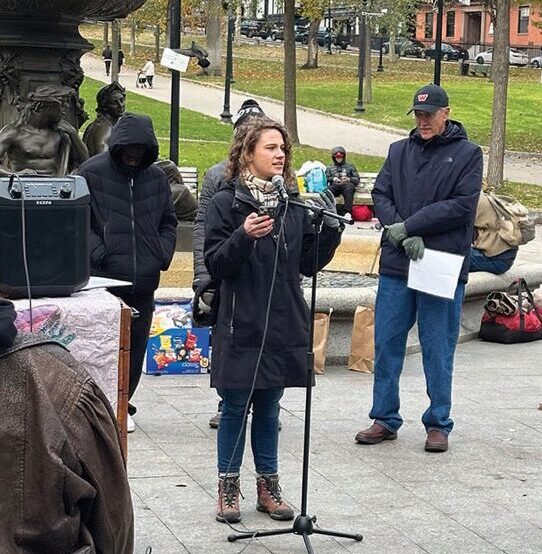
The experience stripped down Olson’s desire to fix and do. Instead, she learned to “sit with people in the suck” and to see them as children of God with not only physical and mental needs, but also spiritual.
“I am a wounded preacher, but I haven’t been judged publicly for my sins. So many of the people I walk with are not seen as valuable or even human. We are all loved and chosen and claimed by God. By not being in relationship with these communities, the church is missing out on sharing immensely hopeful news to a lot of God’s people.”
Olson is bringing her experience with nontraditional ministry as associate pastor of Mount Olivet Lutheran Church in Minneapolis. In addition to serving as the pastoral adviser for young adults, Olson is applying what she learned during her fellowship to the streets of Minneapolis.
“We need people from all walks of life to share their experience of God as living, active, and still speaking,” she said. “It’s a blessing to witness people putting their faith into words, and we are limited when we only hear from the same voice, setting, or perspective.”
Preaching as a communal practice
Katie Weiland ’26 M.Div. is dedicating her six-month fellowship to exploring how ordained ministers and church leaders equip and empower laypeople to proclaim the gospel. Weiland’s project stems from her conviction that preaching is not only a pastoral responsibility but also a communal act for all believers.
“My experiences as a camp counselor and lay professional at Lands Lutheran Church [in Zumbrota, Minnesota] were formative in helping me recognize this broader vocation for myself,” she said. “It was there, in a small rural congregation, that I first encountered the power and promise of lay preaching.”
Weiland is developing a guide for clergy and ministry leaders about preparing others to preach, with a particular focus on biblical interpretation.
“Laypeople know how to tell good stories. They know their congregation, their town, and their people. What makes lay preaching difficult is that people have a hard time speaking with authority about the text or finding appropriate resources to help them do so,” she said. “We lack curiosity and imagination in our own interpretation or simply haven’t been taught to explore the text and research.”
Weiland said she hopes to develop a lay preaching team at her future parish, inviting congregants to join her in wrestling with the text and conducting theological research.
From sermon to conversation
White and Lewis said that much of the Compelling Word Initiative is focused on supporting pastors and congregations working to develop ongoing practices that make preaching more communal. That work complements Luther’s Working Preacher website, which hosted 5.4 million users in more than 200 countries during the past year.
“The Bible is a meeting place with the dead, who still have things to say,” said Matt Skinner, Asher O. and Carrie Nasby Professor of New Testament. “These ancient voices invite us to imagine new ways of thinking about what is right or true or beautiful. They challenge us to consider radical faithfulness and openness.”
In March, Skinner and Lewis presented to a crowd of pastors in Stellenbosch, South Africa, for a continuing education event about preaching on the resurrection. As two of the cohosts of the Sermon Brainwave podcast, they urged attendees to not rush to the “hallelujah” of the event but to acknowledge its trauma, doubt, and uncertainty.
Skinner pointed to the gospel accounts in which people both worshiped Jesus and doubted him. “This reminds us,” he said, “that worship and doubt can co-exist, and that the honesty of doubt is especially important to mention during an anxious age.”
These discussions invite pastors to consider texts from alternative perspectives and give them permission to talk about doubt, fear, uncertainty, and isolation.
They also remind pastors that the Word and worship are enriched when everyone participates more fully: “Find ways to get the text in front of the congregation before Sunday morning,” Skinner said. “They will listen more intently and retain the information better.”
Some pastors are even adopting an improvisational model, where sermons can—and are almost expected to—get interrupted with questions and responses. It’s a movement, Lewis said, to reimagine what preaching is and can be.
Some churches engage congregants through social media or podcasts or by sharing questions before worship. Others open sermons to questions and discussion during the service or create space after worship to discuss key takeaways. The hope, Skinner said, is that sermons offer an encounter with God that people continue to think about long after they leave the sanctuary.
Inviting deeper engagement with the text, White added, creates space for more authentic responsiveness to the text. Listening, he said, doesn’t mean hanging onto every word.
“I love when people come up to me after a sermon and confess they trailed off to think about this or that,” he said. “It means that something in the sermon moved them. I see that as engagement with the text and with God.”
Perhaps that is the invitation at the heart of compelling preaching: not to provide all the answers, but to create space for people to encounter Scripture, one another, and God with enough curiosity and wonder to keep listening.