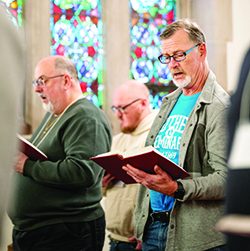
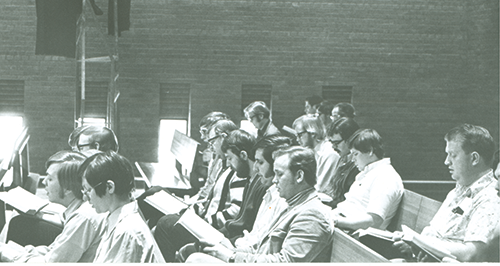
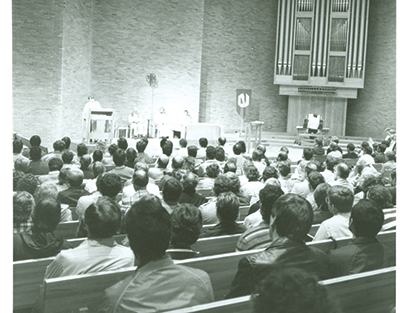
Not so very long ago, students at Luther Seminary were compelled to attend daily chapel. Worship on campus was regarded as a spiritual discipline, a key part of leadership formation for future pastors, and a cherished opportunity for fellowship.
Also: a certain former professor of New Testament was known to motivate worship attendance by marching into the dining hall, blowing a whistle, and ordering, “Get to chapel!”
While faculty no longer employ such measures to fill up the pews today, worship remains central to life at Luther. Through a weekly cadence that mirrors the professional trajectory of a week as a pastor—Bible study, contemplation, sacraments, and fellowship—chapel grounds the community in shared spiritual practices and deepens relationships among students, faculty, and staff.
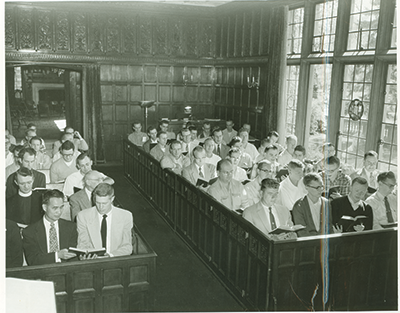
“Chapel is the heart of our communal life,” says Associate Professor Steve Thomason ’15 Ph.D., who was appointed the seminary’s first dean of the chapel in 2024. With daily offerings rotating between Zoom, hybrid, and in-person formats, worship serves as a hub of connection for Luther’s geographically dispersed community—and an important touchstone as the seminary prepares to transition to a new location.
Carolina Bowen ’29 M.Div. serves as a sacristan and director of the choir. “The weekly routine of chapel is a space for us to respond to all we have learned in community,” she says. “We meditate in silence together, sing and pray aloud together, create art, engage each other in conversations, and celebrate the sacraments of holy communion and baptism together”—including, she notes, three baptisms last fall.
“If we just absorb, absorb, absorb theological ideas without corporate worship, we become disconnected from what we are really working towards,” says Bowen. “How can we lead others in worship of a God we have no relationship with?
“In chapel, we take time to build a relationship with God that will sustain us in ministry.”
The people’s song on campus
Throughout its history, Luther Seminary’s chapel leadership has adapted the structures of daily worship to serve the campus community as it transitioned through different eras. For decades, the full-time seminary pastor ministered to a community made up of hundreds of residential students who lived on campus, many without other local ties after moving from other parts of the country or world to attend Luther. In addition to leading worship alongside the seminary cantor, the campus pastor provided pastoral care and spiritual leadership for a community, functioning like a small town, a church, and professional school—all at the same time.
“Chapel is always about worship, not a laboratory,” says Rolf Jacobson ’91 M.Div., dean of the faculty and Alvin N. Rogness Chair of Scripture, Theology, and Ministry. “But you do learn a lot about being a pastor when you’re involved in a worshipping community. For many students, chapel provides their first opportunities to lead prayers, serve as a liturgist and assisting minister, preach, and so on.”
Outstanding preaching and exceptional music have characterized worship at Luther Seminary throughout its history. Then, as now, students would learn about preaching by hearing good preaching. Jacobson recalls sermons from exceptionally gifted faculty preachers like James Limburg ’61 M.Div. and Mary Hinkle Shore—along with occasional creative surprises.
“[Professor Emeritus of Old Testament] Fred Gaiser was the first Luther professor ever to rap a sermon,” Jacobson recalls. “Among many, many excellent preachers over the years on faculty, Fred was one of the best that we had, and he was also among the most experimental. There were also playful initiatives that actually had some pedagogical benefits, like an internal challenge one year among faculty to preach on the most obscure texts one could find.”
Chapel on campus has also featured extraordinary musicians over the years, with leadership by dedicated cantors like Musician Emeritus Mark Sedio and Professor Emeritus of Church Music Paul Westermeyer. For many years, the pastor-cantor partnership represented an important framework for training future pastors and church musicians about both the logistics and joys of working together. Today, sacred music and singing in community—with songs often drawn from the diverse global cultures represented in today’s student body— remain essential to weekly worship.
Leading through change
By 2019, when Jeni Grangaard ’09 M.Div. became seminary pastor, distributed learners made up a larger percentage of Luther’s enrollment, reflecting national trends in seminary attendance. As a result, fewer students were physically present for daily chapel services on campus.
Then COVID started, upending worship everywhere.
One of Grangaard’s immediate challenges was to offer communal spiritual practice without adding one more hour that students had to spend looking at a screen. Part of the solution was to produce a daily prayer podcast called The Liturgy of the Hours that enabled seminary community members to get off Zoom, take a walk, and listen to worship: “from the great cloud of witnesses to the [digital] cloud.”
Grangaard and the chapel team, including student leaders Matthew Jewell ’24 M.Div. and Jami Goetz ’23 M.Div., began experimenting with other ways to be together in community in person and online, including weekly Bible study on Zoom, engaging more students in person and online as sacristans, and—once people could gather safely again—a weekly Lunch Church centered on a simple spiritual practice and a meal.
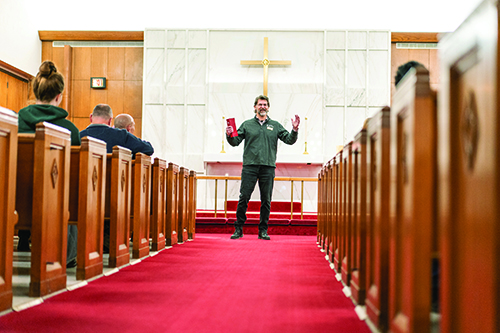
A few years previously, professors Lois Malcolm ’89 M.A. and Kathryn Schifferdecker had begun an effort around sharing personal stories of Christian faith. These “Why Jesus?” talks, often led by faculty, would begin with two simple questions—Why are you a Christian? What difference does Jesus make in your life?—and lead to powerful experiences of Christian community. With the support of faculty leadership, “Why Jesus?” became a regular feature of Lunch Church after the pandemic.
“Lunch Church was part of our lifeline back into community after COVID,” says Grangaard, noting that faculty and students shared leadership.
Grangaard gives credit to Seminary President Robin Steinke for helping the chapel team navigate significant changes in the way community looked during a time of multiple transitions. “[President Steinke] generated a lot of innovative ideas but never told me I ‘should’ do anything. In a really challenging time, she fostered a culture that could shift forward even while being rooted.
“That was a hopeful approach for all of us then, and it’s an approach we will need now, too.”
One body in Christ
Grangaard and Bowen both point to how worship helps the community recognize the diversity of voices in the church through many different ways of preaching, singing, and leading.
“Worship is a place to hear from the many voices that are a part of Christ’s body. The Word of God will sound different when it is embodied by different bodies,” says Grangaard. That’s true of the Luther Seminary community, which gathers students from across the United States and throughout the world. The proclamation of the faculty has long left the largest imprint in the chapel. “The faith of the Luther faculty is deep,” says Grangaard. “There’s a lot of firepower there when they get to share it in community.”
Today, in any given chapel gathering, that microcosm of the body of Christ might include commuters, who often drive in for worship even if they don’t have class; international students, whose worship language is not usually English and whose style is not North American, even if they are Lutheran; an ecumenically diverse group of residential domestic students; and faculty and staff, who may or may not have another home congregation.
For Bowen, this diversity reflects a larger truth about the family of God.
“I’ve needed the power and rhythm of faith from cultures different than my own, the peaceful meditations of choir music, the enthusiasm of praise, and the thorough petitions of chanting the Great Litany [to navigate through difficult times],” she says.
“The mixture of chapel experiences here at Luther Seminary reflects the diversity of ways that people worship their creator the world over. We as Christians are a part of a community much larger than our church, synod, denomination, and country. Through worship, we join with the global community of faith.”
A week in the worship life of Luther Seminary
Monday: Text Study
Students join the weekly text study on Zoom, introducing themselves with their name and location. Some call in from on campus, while others are further afield throughout Minnesota and neighboring states. As they prepare to dive into this week’s texts from the Revised Common Lectionary, participants share what they bring to the table today: their worries, their feelings, their attitude.
Then, they read through the texts: Exodus 17:1–7, Psalm 95, Romans 5:1–11, and John 4:5–42. Each person shares their observations and wonderings aloud. Some make notes.
“Now that we’ve heard from each other, what might God be speaking to us in these texts?” Dean of the Chapel Steve Thomason ’15 Ph.D. asks.
The students share again, building on one another’s ideas, and brainstorming ways to approach the texts in preaching and teaching in the coming week. They explore water imagery and discuss how far back people have wondered, “Is the Lord truly among us?”
Some are looking for ideas and conversation knowing they are going to be at the pulpit on Sunday; others come simply to encounter the Scripture at the start of their week. After 45 minutes, conversation wraps up and they log off.
They leave with gratitude.
Tuesday: Contemplative Practice
“We light the candle today as a physical symbol of the Holy Spirit, who draws us together, who is our light,” Thomason says as he stands in the middle of a circle of chairs in the OCC meditation chapel and lights a candle. The flame will serve as a focal point during the contemplative practice for the students, staff, and faculty in attendance. One participant joins via Zoom— they’re given their own chair.
Thomason passes a small wooden cross around the circle as a talking piece. Each person states how they are arriving today as they hold the symbol carved out of wood from Israel.
Psalm 95 is read aloud once and Thomason sets his timer for 15 minutes. During this time everyone remains silent. They’re welcome to spend the time anyway they’d like. A selection of art supplies are provided for those interested. Thomason says that he believes engaging in contemplative practices in community is an important way to allow the Spirit to move. After 15 minutes, he begins to speak.
“I invite us to take a couple of deep breaths and come back together.” “How are you leaving this place?”
The wooden cross is passed again. Thomason blows out the candle. They leave centered.
Wednesday: Service of Holy Communion
This week’s student-organized and -led service in the Chapel of the Incarnation opens with music before Vamsi Ratnam Kagitha ’27 M.A. and Danielle Dokman ’26 Ph.D. lead confession and forgiveness, as well as confession of sin as a group. The gathering song, “When the Light is Gone,” is sung. The gospel from John 4 is read. A group of six gathers in a semi-circle to sing an African melody, “We Have Prevailed.”
Preaching today is Peter Okeyo ’27 M.A. His sermon, “The Four Words That Changed the Story,” is a part of the Lenten series, “Encounter With Christ.”
“God has the power to change your story,” Okeyo says.
The hymn of the day and prayers of intercession follow the sermon, along with collection of an offering for student grocery assistance. This week, the words of institution are read in Dutch before the Eucharist and the Lord’s Prayer.
They leave with a blessing.
Thursday: Lunch Church
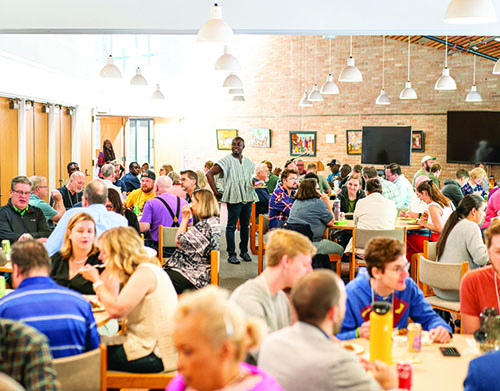
At 10:50 a.m., students, faculty, and staff begin to gather inside the campus center atrium. They pour through each door, down the stairs, and out of the admissions office, following the laughter and delicious aromas of today’s hot lunch.
Thomason welcomes the gathering, prays for the food, and asks everyone to start thinking of a story of light in the darkness.
After filling their plates with macaroni and cheese, greens, and a cabbage slaw, participants take their “comfort food” into the dining room. The six overflowing tables don’t hesitate to dive into the meal, as people begin exchanging “light in the darkness” stories.
On Thursdays, Lunch Church is held as a time to come together over a meal. Respite. Fuel. Fellowship. The Gospel is read aloud—John 9—and Thomason cycles through slides of artwork on this passage on the screen. Some follow along with the text, while others follow the art. Some close their eyes and listen.
After the reading, it’s time to get creative. Throughout Lent, Lunch Church has been dedicated to creating a community art project. Today’s medium: a magazine collage. Plates are cleared and the room fills with the sound of scissors, glue sticks, and chatter, as each table starts exploring how they want to reflect the Scripture in their art.
One piece is made entirely of skies and windows, while another features like-colored pieces together in rainbow order. After an hour, people began to head back to their responsibilities.
They leave full. And wait for a new week.
The wholeness of the community
The seminary first considered a dean of the chapel model in the late 1980s but operated with a seminary pastor model for the last four decades. In 2024, when Grangaard discerned a call back to congregational ministry, the time was right for a change. Today, as dean of the chapel, Thomason serves as both a faculty member and provides leadership for the seminary’s worship life.
“I teach leadership here academically, but I also teach leadership as dean of the chapel now, by how I’m leading,” he says. “Whenever I’m with the student sacristans, every time I step into the chapel, it’s a classroom, where I am modeling—for better or worse—pastoral leadership.”
Thomason is sensitive to power dynamics that weren’t present when the seminary pastor was not a faculty member. While he still participates in academic advising, he has stepped back from candidacy meetings and interviews. He leaves the room when candidacy matters come up in faculty meetings in order to avoid situations that could get in the way of pastoral care. He also works closely with student affairs leadership to be intentional about what he calls “the wholeness of the community.”
A big part of that “wholeness” is breaking bread together. In addition to keeping Lunch Church going strong, the chapel and student affairs teams host “Chapel Café” after Wednesday worship on campus. “The way we think about the whole hour on a Wednesday is 40 minutes of word and sacrament and 20 minutes of sacramental fellowship,” Thomason says. “After worship, we serve up good food and have the cafeteria tables open, so people sit down, have more fellowship, and build more community.” The success of Lunch Church and Chapel Café has provided motivation and a model for other hospitality opportunities on campus, like recent endowed lectures that have included table conversation over a shared meal.
This focus on relationships, rooted in his theology, is an intentional part of Thomason’s leadership as the seminary approaches a period of significant transformation.
“Our encounter with Christ is the encounter with others,” he says. “How do we build trust and cultivate a community of trust? I think this is the only way we can navigate this upcoming campus move.”