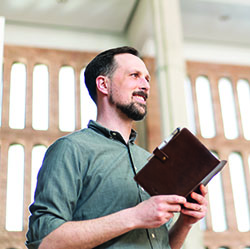
Before they ever set foot in a Luther Seminary classroom, Aaron Schutte ’26 M.Div., Anna Belz-Brock ’29 M.Div., and Chelsey Hinrichsen ’28 M.Div. were already practicing the kind of leadership the church needs most.
Schutte grew up in a small-town Lutheran congregation where leadership looked like pitching in—helping with Sunday school, Vacation Bible School, and eventually serving as a camp counselor. Later, his sense of call stretched far beyond his home congregation when he spent four years teaching in Tanzania through the ELCA and the Metropolitan New York Synod, discovering firsthand the depth and diversity of the global church.
Belz-Brock’s leadership story began with an early love for Lutheran theology. By age 13, she “soaked it up like a sponge,” and that passion propelled her into outdoor ministry, Bible camp, and the founding of a youth group at her church. In the relentless busyness of high school, she remembers rushing through homework for the sake of something that mattered more—making space for her peers to gather, worship, and grow together.
Hinrichsen came to Luther Seminary with a foundation formed in the LCMS, one she describes as “incredible” in shaping her faith. Over time, that foundation led to a search for a new church home with the ELCA. In her new congregation, she served as digital media director, creating a modern presence for online worshipers. She also helped organize her church’s PRIDE presence, fully committed to LGBTQ+ allyship and building a community where more people can belong.
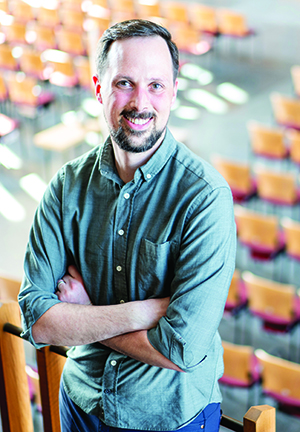


Together, these three students embody the empowering effects of the ELCA Fund for Leaders: a scholarship that opens doors, expands imagination, and helps scholars say “yes” to possibilities they might not otherwise have been able to choose. That theme echoes a line used to describe the Fund for Leaders impact: “We are a church that believes Jesus is God’s ‘yes’ to us. Our lives can be a ‘yes’ to others.”
For Schutte, Belz-Brock, and Hinrichsen, the “yes” is both the practical covering of costs and the affirmation from the wider church that their gifts are seen, needed, and worth investing in.
Three scholarships, one mission: raising up leaders for the Church
The Fund for Leaders exists to raise up rostered leaders by providing scholarship support that makes seminary education more accessible—and sustainable—for students across seven ELCA seminaries. In anticipation of its 30th anniversary in 2027, the program continues to achieve record-breaking milestones. In the 2024–25 school year alone, the Fund for Leaders provided more than $3 million in support to 350 ELCA seminary students. Schutte, Belz-Brock, and Hinrichsen—three of 36 current Luther Seminary Fund for Leaders scholars—represent three unique scholarship pathways, each reflecting the church’s diverse and changing needs.
The ELCA Fund for Leaders awards scholarships to students seeking to become ELCA rostered ministers who have begun the candidacy process in their synod. The program, which awards scholarships for the duration of students’ required seminary work, is open to new students enrolled in the upcoming fall semester or those who have completed no more than one semester. Luther Seminary awards an additional $750 stipend for every course covered by the Fund for Leaders scholarship.
This scholarship is available, by invitation only, to current students, including Theological Education for Emerging Ministries candidates, who are identified and nominated by their seminary in coordination with their synod bishop and director for evangelical mission.
This scholarship, awarded through ELCA Federal Chaplaincy Ministries, provides funding for students who are attending an ELCA seminary and preparing for ministry as a military, Veterans Affairs, or federal prison chaplain.
Saying yes to connection: the community Fund for Leaders builds
Since the program’s creation, over 1,100 qualified candidates have received more than $28 million in scholarship support. For these candidates, the Fund for Leaders is not merely a line item in a financial aid package. It is also a network of relationships— connections that stretch across classrooms, seminaries, synods, and vocational pathways, creating a wider sense of belonging within the ELCA. The Fund for Leaders also hosts online discernment groups, providing a nurturing environment for all participants to explore their vocational calling and engage in meaningful conversations about their faith and leadership potential.
After receiving the Direct Full-Tuition Scholarship in 2020, Schutte recalls the online announcement ceremony that allowed him the opportunity to connect with other scholars and ask questions of then-Presiding Bishop Elizabeth Eaton. At Luther, Schutte’s connections continued through admissions call campaigns, linking prospective students with Fund for Leaders recipients. Practical conversations like these became a form of peer mentoring, offering the insight of a seminary experience within reach.
Belz-Brock’s story highlights another kind of connection: the power of being seen by someone who knows your gifts.
Although she had heard about the Fund for Leaders while researching seminaries, she didn’t pursue it at first. The turning point came during her first year at Luther when Terri Elton ’98 M.A., ’07 Ph.D., dean of academic affairs and professor of leadership, nominated her for the Mission Developer Scholarship.
“It was such an honor to get that email from her,” Belz-Brock says. “I was in her Christian public leader class, and I think it was right after we had submitted our midterm papers, where we interviewed people who were not part of Christian communities. I walked into a metaphysical gift shop and asked somebody if they’d be willing to have a conversation about what they thought about God, Jesus, and church. That was a really cool experience, especially because I had gone to that shop before.”
Hinrichsen says vocational conversation early on in her seminary journey is what dialed her into the Fund for Leaders—specifically the Federal Chaplaincy Ministries Scholarship.
“I’d had thoughts to myself and conversations with God over the years about being a chaplain. When the idea of chaplaincy was proposed, it was one of those moments where a question from the outside comes in, and all the pieces coalesce,” Hinrichsen says.
“I knew before seminary that I wanted to work with veterans, so a federal chaplaincy role in the VA aligns perfectly with that.”

Saying yes to leadership: a new and ever-changing definition
The Fund for Leaders helps students say “yes” to the kind of leadership the church is called to embody today. For the three scholars, this involves a careful combination of equipping others, using your voice, knowing what is most important, pursuing your passion, and recognizing your privilege.
As a white male within the church, Schutte speaks candidly about how leadership is shaped by awareness of historical power while simultaneously finding opportunities to listen and amplify the voices of others. He says a critical part of this work is recognizing the richness of the global church, its diverse leaders, and its different rosters.
“For me, it’s important to shift this vision of who is a leader in the church,” he says. “Thinking about our youth, our elders, and the huge range of what the church is. Who can I continue to equip to be the next leaders? That’s a beautiful thing about leadership within the church.”
Belz-Brock’s leadership language is shaped by urgency and complexity. She observes that church leadership is pulled in many directions: pastoral care, liturgy, and formation, to name a few. And although being a pastor has never been easy, she says it’s become even more difficult over the past few years.
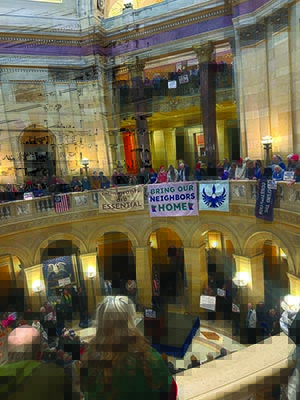
“One common thread for me has always been theology and faith bound up with justice and liberation,” she explains. “There are a lot of Lutherans in Minnesota that are vocalizing to stand up for their neighbor. It’s a really interesting time of immense change, and people are waking up to injustices that have been here the whole time. All over the board, responding to the times right now is essential.”
Hinrichsen defines leadership as using your voice, but she quickly expands what that means: not just speaking, but putting faith and values into action in ways that make the world better. She acknowledges a Midwest instinct to avoid “ruffling feathers,” and she challenges it directly—because complacency can create space for oppression to persist.
Wanting to be seen as a person of action, Hinrichsen asks herself a series of questions when it comes to leadership within the church: Who’s being held back? Where am I being moderate? Where am I being too silent? What is the church now, today? What is the need for the church, and how do we meet that need? What did the very first followers of Jesus do?
For Hinrichsen, leadership is a balancing act of intention and personal passion.
“All of us are passionate about different things, and we can’t fake that,” she says. “The things that make your hands sweaty or make your ears perk up or make your heart beat fast. Not everything does that. So when it does happen, you listen and know that this is where you are called to act.”
Saying yes to experience: how the Fund for Leaders funds more than an education
In the end, the most powerful “yes” that the Fund for Leaders scholarship enables is the simplest one: Yes, I can attend seminary. Yes, I can do this without drowning in debt. Yes, I can say yes to formation—not just survival.
Schutte puts it plainly: He would not have gone to seminary if it hadn’t been for the combination of his Fund for Leaders scholarship and the Jubilee Scholarship. Together, those supports removed the financial barrier that so often determines who can pursue a call. Having earned the Direct Full-Tuition Scholarship, Schutte also has many of his practical needs accounted for, including books, food, transportation to campus, and assistance with housing. And when travel courses emerged, it has been a relief to know the majority of associated costs could be covered through Fund for Leaders support and the stipend he received from Luther—making it easier to say yes to unique opportunities.
“The coolest experience I had at Luther and through the ELCA was attending the Lutheran World Federation Assembly in Poland. Just meeting others and hearing about their experiences was one of the best cross-seminary experiences. I also went to Guatemala and Mexico with a course through Luther, learning about immigration. Going forward, I know that, through these opportunities, I have a deeper understanding and a broader view of what the church is and how to bring that global vision of the church forward,” Schutte says.
For Belz-Brock, the scholarship was not only financial—it was an affirmation. Being nominated and accepted felt like “the church saying yes” to her, recognizing her strengths and potential to form new and experimental communities. She also earned the freedom to learn without scrambling to add more sources of income, allowing her to go at her own pace and fully absorb her seminary education, rather than rushing through in order to start earning money. With the Jubilee Scholarship and Fund for Leaders support together, Belz-Brock describes a kind of breathing room that lets her stay immersed in coursework, continue the ministry work she’s passionate about as a part-time children and youth minister, and remain available to her neighbors in a demanding moment in Minnesota’s public life.
Hinrichsen describes Fund for Leaders as both enabling and freeing, allowing her to live comfortably without having to spread herself too thin. Most strikingly, she doesn’t have to work while in seminary—meaning she can pour her whole self into formation. She says she fully dives into the work: making office hours appointments with professors multiple times a month, meeting up with classmates, and attending chapel online, among many other connection points that have added immense value to her seminary experience.
“It’s been a beautiful gift, not just monetarily, but spiritually,” she says. “I have this philosophy that if you’re doing God’s work, the money shows up to make it happen. When I start to have doubts, something that I didn’t even expect shows up.”
The Fund for Leaders is not simply funding degrees. It is strengthening the church’s capacity to love neighbors. It is enabling leaders-in-formation to say yes to study, yes to community, yes to global learning, yes to justice-focused ministry, yes to innovation, and yes to the long, patient work of equipping others.
And because they can say yes, others will be able to say yes, too.