It can be tempting to view the move away from St. Anthony Park as a seismic change for Luther Seminary, a great leap into the unknown after 120 years rooted in a singular place. In some ways, it is. “A few days after we announced the board’s decision to sell the Upper Campus,” said President Robin Steinke, “a faithful supporter said to me, ‘I can’t believe you announced the sale without knowing where you would be going next.’
“I told him, ‘Me too.’”
But in recent years, as the cost of maintaining the seminary’s aging infrastructure began to diverge from the realities facing today’s students, seminary leadership felt a profound sense of call to make a decision about the campus—and to do it at the right time.
“During the period between announcing that the campus would be sold and finding our next home, I thought often of Lydia in Acts 16,” said Steinke. “As the first-century church knew, Christian hope doesn’t arise from denying difficulties. It comes out of the courage to name reality truthfully and still, in that moment, trust that God is opening a new path before us. And that’s where we continue to find ourselves.”
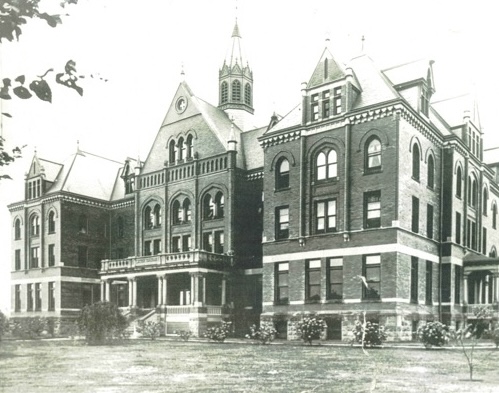
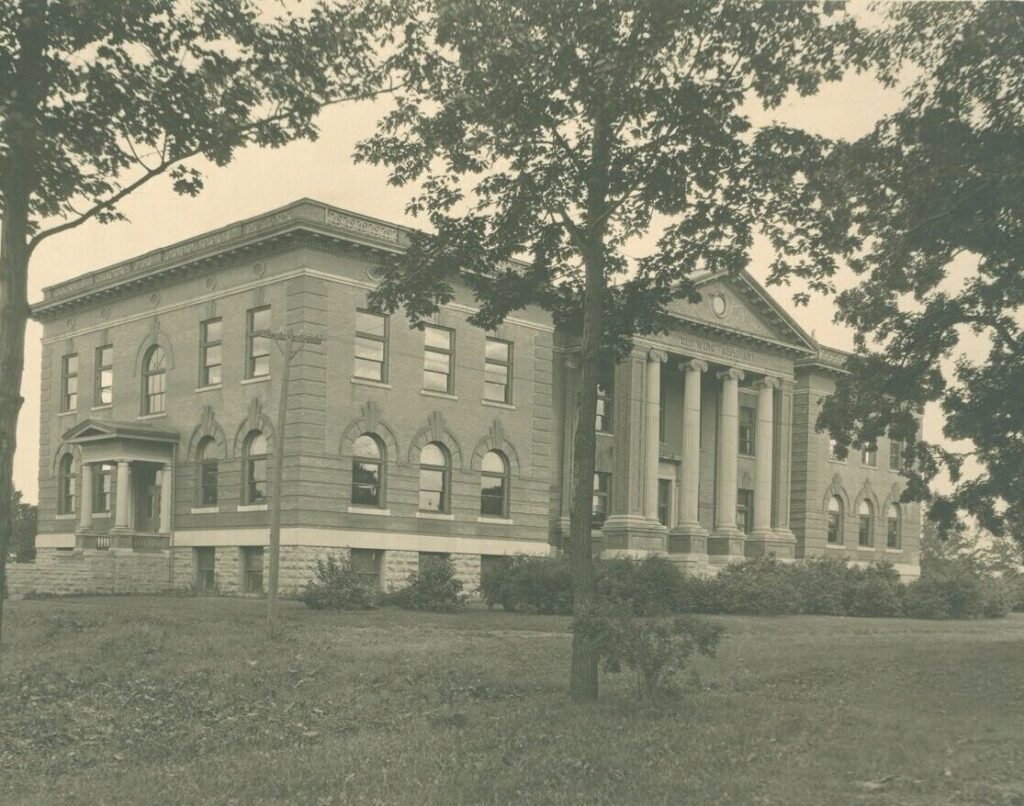
Despite its long history in St. Paul, change is a consistent thread in the fabric of Luther Seminary. Founded by Norwegian immigrants seeking a place to put down roots, Luther moved more than a dozen times in its early years. Its identity in the decades since has been shaped and reshaped by mergers, consolidations, and partnerships—not unlike American Lutheranism itself. Today, that dynamic story continues to evolve as the seminary community prepares to relocate to River Parkway Place, its new campus in downtown Minneapolis.
“In previous generations, seminarians would spend three years in residence on campus, go out for an episode of immersive contextual learning during internship, return to campus to complete their studies, and be sent out to wherever the church had need of them,” said Steinke.
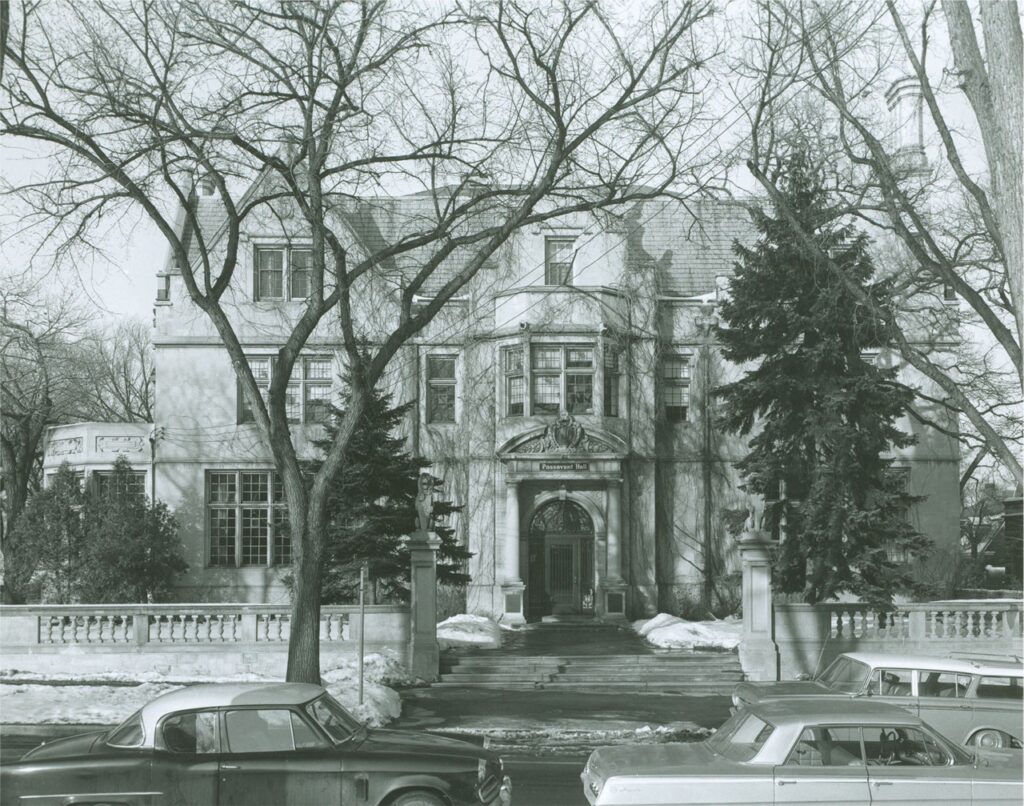
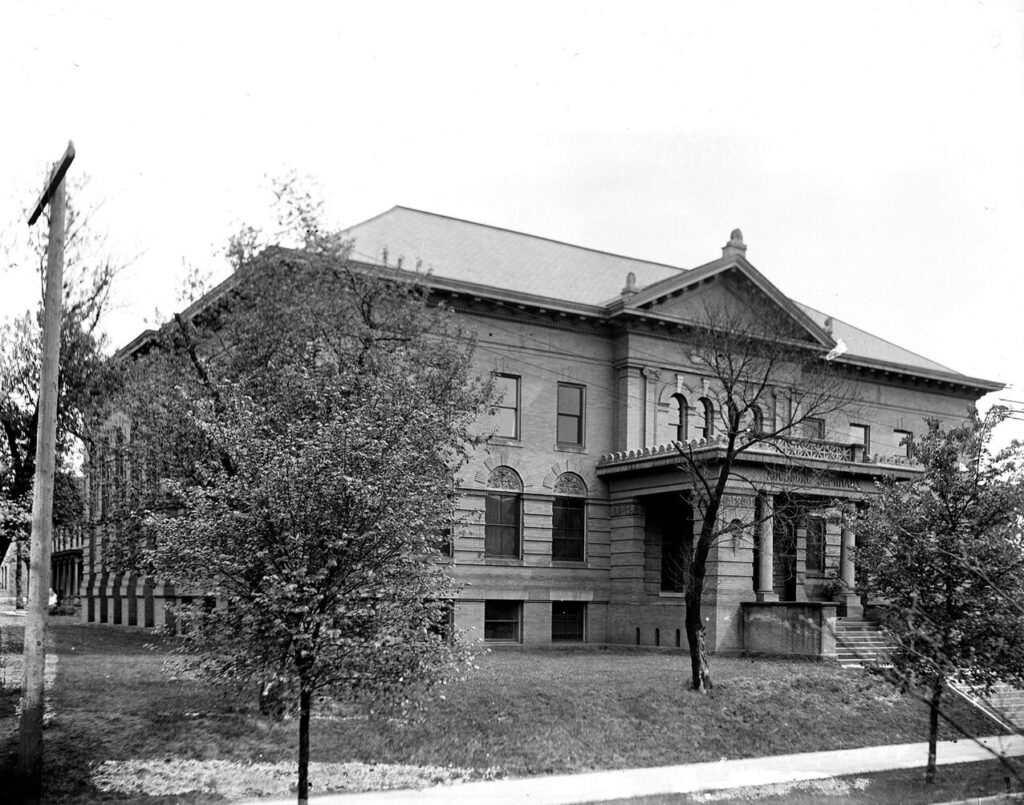
Accordingly, the campus was designed to support a large residential community. But over time, a greater percentage of students began to elect distributed learning options, staying and serving in their home communities while attending seminary. The MDivX experiment from 2018 to 2023, in which the seminary successfully piloted an accelerated Master of Divinity degree program, laid the groundwork for creative imagination about how to better meet the needs of Christian leaders, the majority of whom are unable or unwilling to relocate to campus for four years today. Advancements in remote learning technology and the COVID-19 pandemic only accelerated these trends.
“Today, face-to-face learning, while essential, is episodic for the majority of our students,” said Steinke. “As the church has changed its need for more leaders who stay rooted in context for the duration of their study, Luther Seminary needs to change our place—perhaps becoming more like our itinerant Norwegian ancestors.”
A comprehensive facilities evaluation in 2024 calculated the anticipated cost to address deferred maintenance on Luther’s campus at more than $30 million, on top of $1.5 million in annual operating expenses. With a robust endowment and a strong base of individual donor support, investing in a comprehensive overhaul of the campus was one possibility. But would maintaining the historic buildings in St. Paul be the most faithful use of the seminary’s resources?
Would it serve the mission over the long term?
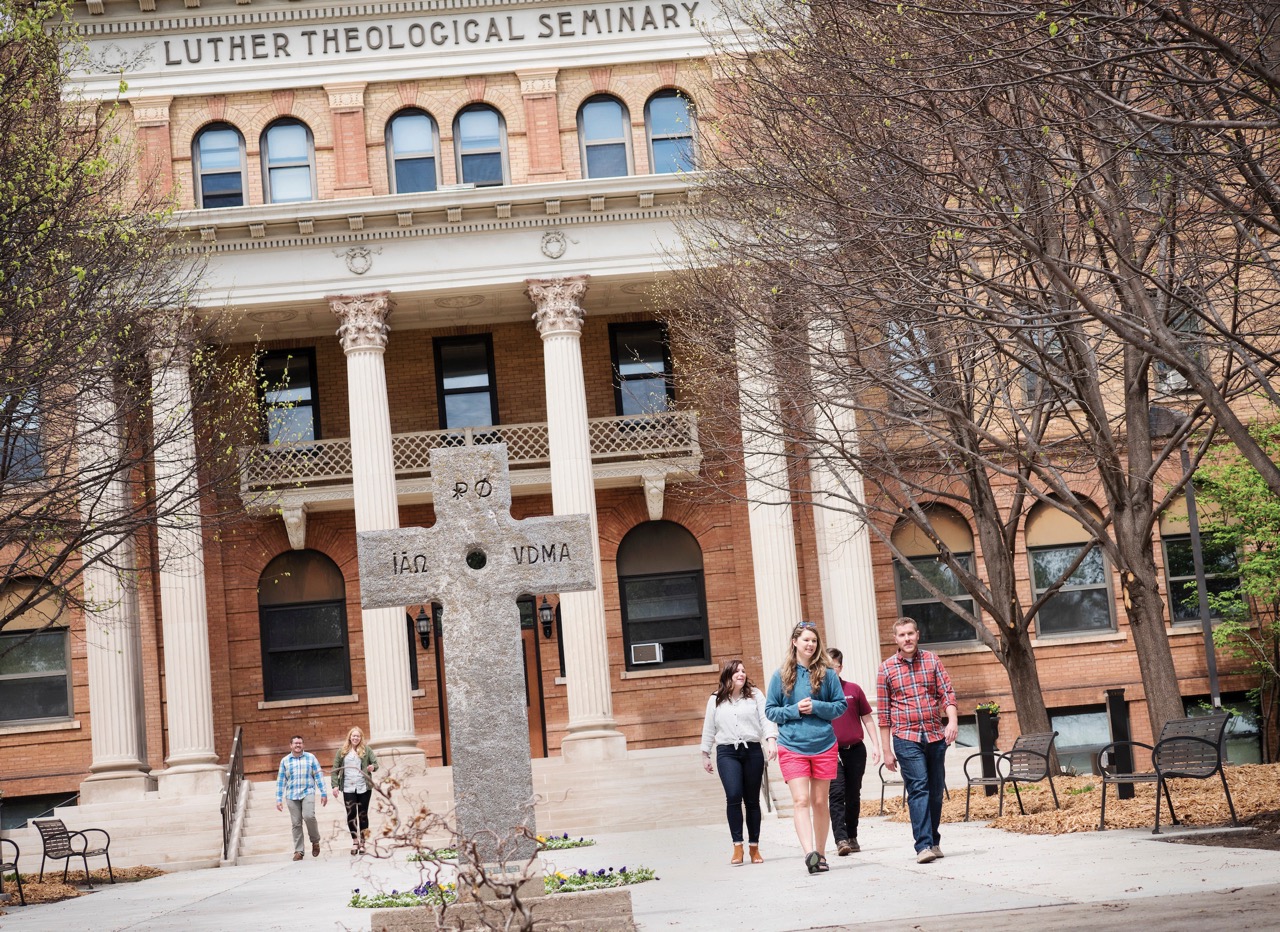 In May 2025, in an emotional decision, the board unanimously voted to sell the Upper Campus and seek new space. Now, after more than a year of listening, visioning, seeking, and opening up to new possibilities, Luther Seminary has found its new home.
Today’s Luther Seminary requires a physical footprint that is both smaller and more flexible, reflecting education that takes place not just in the classroom and through formal degree programs, but online and around the world; a smaller residential community with a large proportion of international students; and an evolving reality of theological education that is contextually responsive and rooted in community.
Members of the seminary brought deep longings to the process of imagining a new space.
Would there be a sense of connection to nature and creation?
Would the community be able to worship and break bread together?
Would the new space carry forward and celebrate our history?
These considerations, as much as requirements around technology and square footage, drove the campus search process. Led by a working group that included Steinke, Vice President for Seminary Relations Heidi Droegemueller, Associate Professor of Congregational and Community Care Leadership Cody Sanders, Senior Director of Operations and Technology Chris Jacobsen, and Dean of the Faculty Rolf Jacobson ’91 M.Div., seminary leadership reviewed 36 potential properties, visited 8 sites in person, and invited 3 finalists to submit proposals. The Board of Directors visited two finalist sites in May and subsequently voted unanimously to pursue a long-term lease with River Parkway Place.
“Recognizing that much of our current physical campus doesn’t fit our ways of being today, we knew we had to be willing to step out into something new when we didn’t know at the outset what it would look like,” said Sanders. “But we went with an openness to find where the Spirit was leading in the configuration of our institution.”
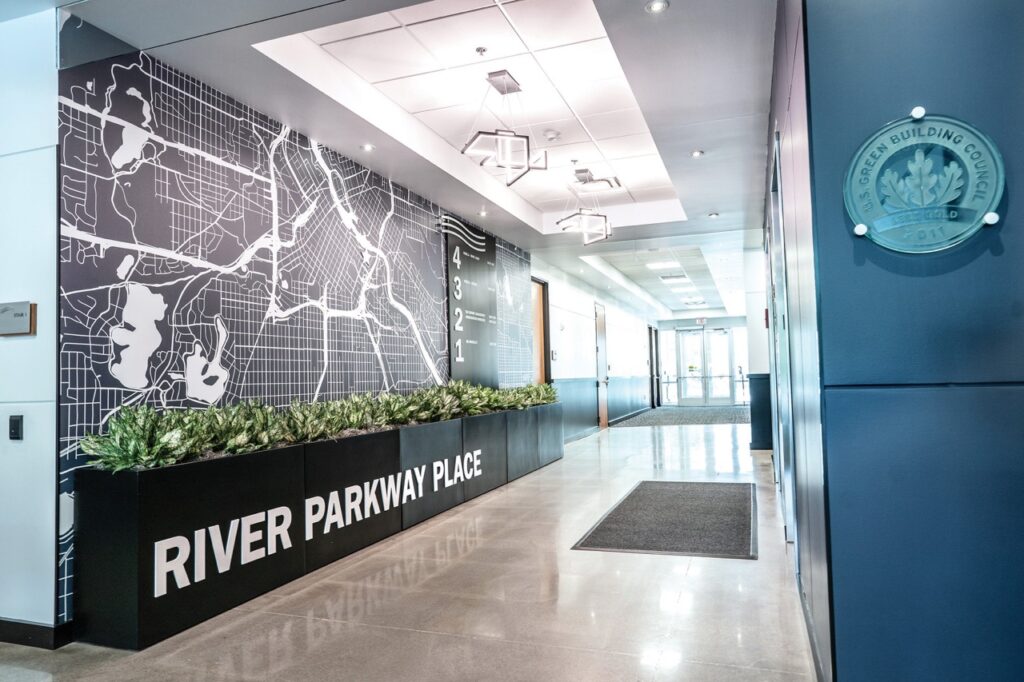
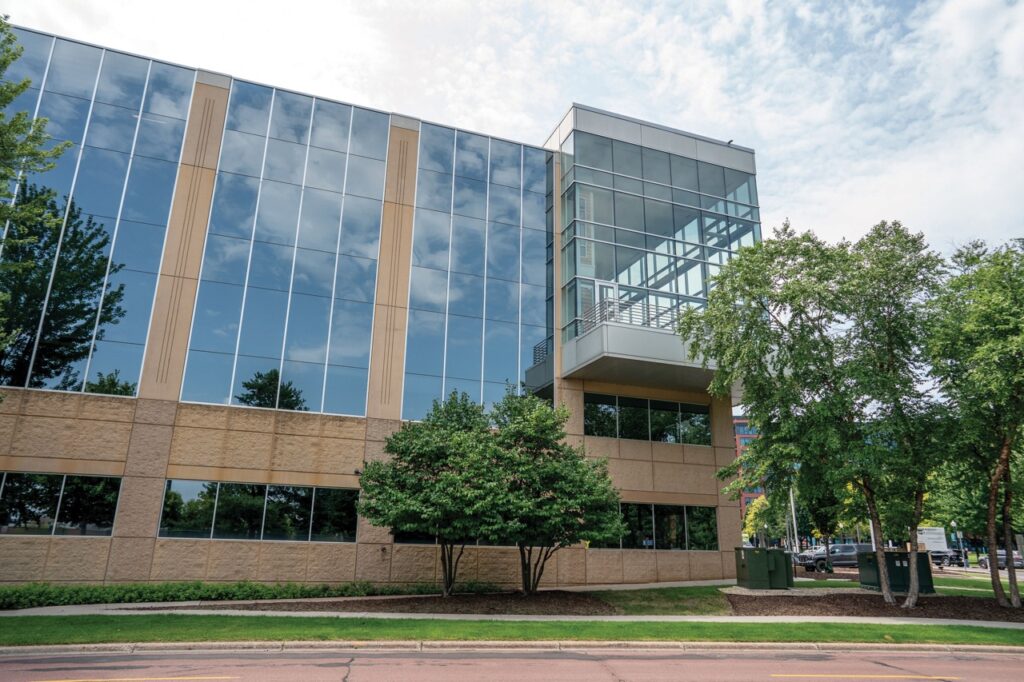
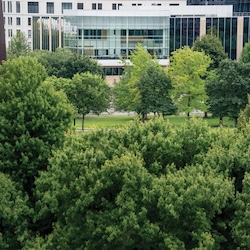
If not for a few buildings and trees, a person looking southwest outside Bockman Hall could see River Parkway Place. The four-story building, constructed in 2001, sits alongside the Mississippi River in east downtown Minneapolis, close to the Guthrie Theater, Gold Medal Park, and the Stone Arch Bridge. Over the next several months, the seminary will partner with local architecture firm RSP Architects and Gardner Builders to design and build out the space in advance of a move-in date of July 1, 2027.
“The new campus represents the trajectory Luther is on to be highly responsive to the needs of students,” said Sanders. “We have a genuine commitment to be in a physical space with a front door, a hospitable building that can cultivate community for the people here every week of the year as well as for the enormous number of our students learning from a distance, who come to campus a few times each year. We’ve found a place that will do both those things.”
The seminary will primarily occupy the third and fourth floors of River Parkway Place, with a welcome desk and the library on the first floor. Flexible classrooms will be able to accommodate between 10 and 150 students in various configurations made possible by movable walls, with seamless technology that will deliver the same learning experience both in person and online. Ample gathering areas throughout the building will invite students and guests to linger for study, conversation, and connection.
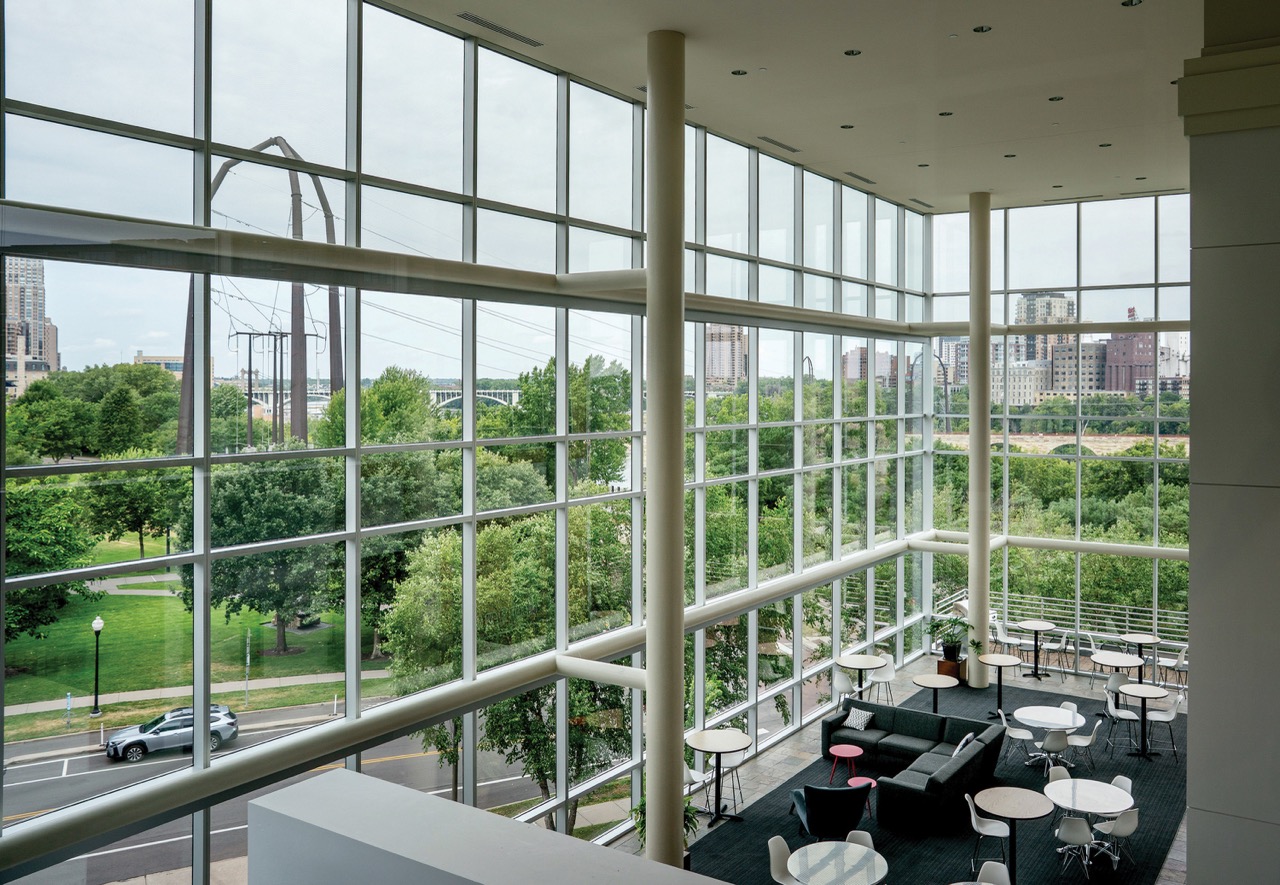 A large, two-story atrium will anchor the campus as the central worship and gathering space, with seating for up to 150 and a flexible layout for different worship formats. “The atrium where we will worship blends a liturgical interior space with the ecological space just outside the windows,” said Sanders. “I’m excited for the ways this proximity to nature will enhance our worship.”
In addition to greater functionality, the fully accessible and LEED Gold–certified building will deepen the ways in which the seminary can live into its commitments to hospitality, environmental sustainability, and teaching flexibility, said Derek McCallum, design principal at RSP and design team lead on the project.
“We’ve studied the teaching commitments of your faculty and know how advanced Luther is in higher education delivery—from having in-person, hybrid, and online teaching to having domestic and global students. Now you’ll have spaces configured in ways that support your leading-edge teaching.”
The new space will reflect aspects of Scandinavian design, highlighting the seminary’s heritage. Caleb Rollins ’24 M.A., seminary archivist, also provided a selection of Edward Sövik’s writings on religion and architecture to the project team. Sövik was an influential liturgical architect who studied at Luther in the early 1940s. McCallum engaged deeply with Sövik’s ideas during the design process.
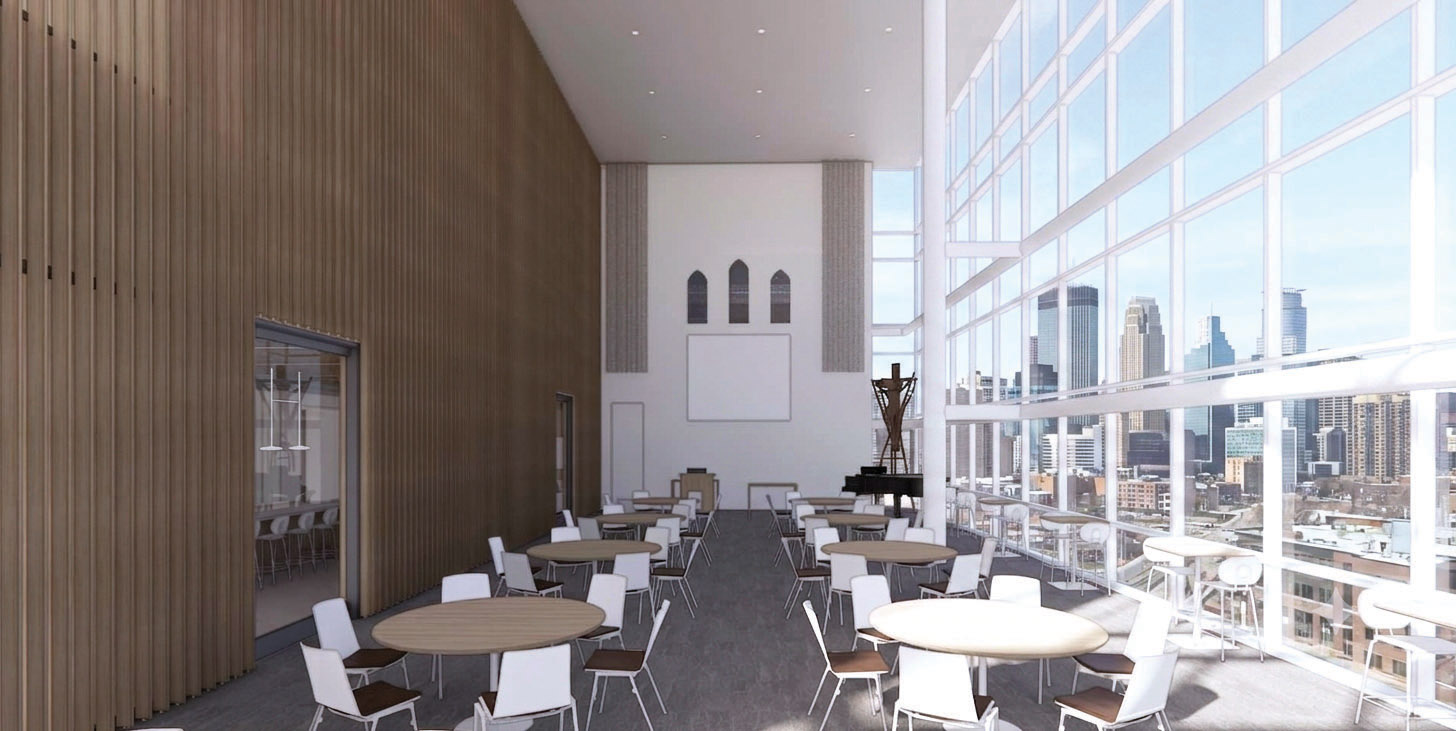
“That engagement with [Sövik], who himself studied at Luther, was a sign that our architecture partners would be designing a space that was not only beautiful but developed with theological ideas in mind that were specific to Luther Seminary and its past,” said Sanders.
While River Parkway Place does not include on-site housing for residential students, Luther will offer year-round housing at nearby Augsburg University, located approximately one mile away. The two institutions have shared various administrative functions since 2018, and the opportunity to expand their partnership into student housing made sense. At Augsburg, Luther students will have access to the full range of university amenities, including dining and fitness facilities, a free public transit pass, library and study space, and the ability to participate in campus activities.
Current Ph.D. student Gladson Ishaya ’26 M.A., a residential student from Nigeria who serves as president of Luther’s student council, said, “My heart ached when we first received news of the move to another campus. I had many questions about what the new campus would be like. But I’m committed to having a positive attitude about these changes, whatever my own personal feelings are, because I know this is a good change for the seminary, for all of us students, and for the church.
“I’m excited about having our residences on campus at Augsburg, with access to amenities like a gym, different residential options, and a more diverse neighborhood,” he added. “Community is a vital part of student life, and now we’ll be able to gain the perspectives of undergraduates at a Lutheran university that has a diverse student population studying in a variety of disciplines, not only theology.”
Luther’s distributed learners, who make up roughly 70% of the student body, share in the complex mix of emotions around the move.
“I was at first surprised at how the news of the move impacted me, but it continues to make sense to me. Even though I attend many classes from my couch, I always have the feeling that I am part of the Luther community—and I don’t think we’ll lose that when we move,” said Mark Cuilla ’30 M.Div., who lives in Spokane, Washington.
I’m excited to be in the new space and see how it brings us all together, and I also want to stay attentive to others’ grief. We hold each other with compassion and recognize that we’re all experiencing this move in many different ways.
—Mark Cuilla ’30 M.Div.
Partnerships with rural communities in the church will matter even more with the move into an area of mixed socioeconomic status, higher housing density, and all the complexity of an urban environment, Steinke said. Along with new neighbors, the seminary will need to attend to the history of the site, which holds significance for Indigenous communities as well being the economic foundation of the city of Minneapolis. The river provides a constant reminder of the connection between people and communities, both past and present.
“We’ve worked to adopt the metaphor of a river into the design—the essence of continuity, the way a river gives life, the idea that you will never step into the same river twice. There is a spirit of movement and life in this space along the river that I think Luther will thrive in well,” said McCallum.
For Ishaya, that spirit of movement is both poignant and familiar. “From time immemorial, human beings have been moving from one place to another. Families move from one home to another, and so do churches and schools. Certainly all of us international students have made significant transitions in recent years. This is part of human life, to move around and to see what the world is all about.”
For many years, Steinke has maintained a spiritual practice of praying for the people downstream whenever she crosses the Mississippi. “As we make this move, we are called to bear witness to history and the ways in which the church is changing,” she said.
“I can’t think of a better place from which to do that.”